
Intussusception in Children: Symptoms, Causes, Diagnosis and Treatment Bangalore
Watching an otherwise healthy baby suddenly scream in inconsolable abdominal pain, pull their knees tightly toward their chest, and then abruptly fall quiet minutes later is every parent’s worst nightmare. While many infant tummy aches stem from routine gas or colic, sudden, cyclic episodes of severe pain can signal a time-sensitive surgical emergency known as intussusception.
Intussusception is the leading cause of acute intestinal blockage in infants and toddlers between 3 months and 3 years of age. When diagnosed within the first 24 hours by an experienced pediatric surgeon in Bangalore, over 85% to 90% of children can be treated safely without a single surgical incision. However, delaying medical evaluation risks cutting off blood supply to the bowel, turning a non-surgical fix into an urgent operation. At Kshema Pediatrix in Basavanagudi, Bengaluru, Dr. Ramesh Santhanakrishnan and our multidisciplinary pediatric team provide rapid evaluation, accurate ultrasound-guided diagnosis, and comprehensive care for families across South Bangalore and Karnataka.
What Is Intussusception in Children?
Intussusception occurs when one segment of a child’s intestine slides or folds inside the adjacent section much like the segments of a collapsible telescope sliding into one another. Most commonly, this happens at the ileocolic junction, where the end of the small intestine (ileum) telescopes into the beginning of the large intestine (colon).
This telescoping triggers two immediate, dangerous chain reactions inside your child’s abdomen:
- Mechanical Bowel Obstruction: Food, digestive fluids, and gas can no longer pass through the narrowed intestinal channel, leading to severe cramping, bloating, and persistent vomiting.
- Vascular Compromise (Ischemia): As the inner bowel segment (intussusceptum) gets squeezed inside the outer segment (intussuscipiens), the delicate blood vessels supplying the intestinal wall become compressed. Within hours, swelling worsens, blood flow drops, and the intestinal lining begins to shed blood and mucus making prompt intestinal obstruction treatment in children Bangalore critical to prevent tissue death (necrosis) or a life-threatening tear (perforation).
Early vs. Late Symptoms of Intussusception Parents Must Never Ignore
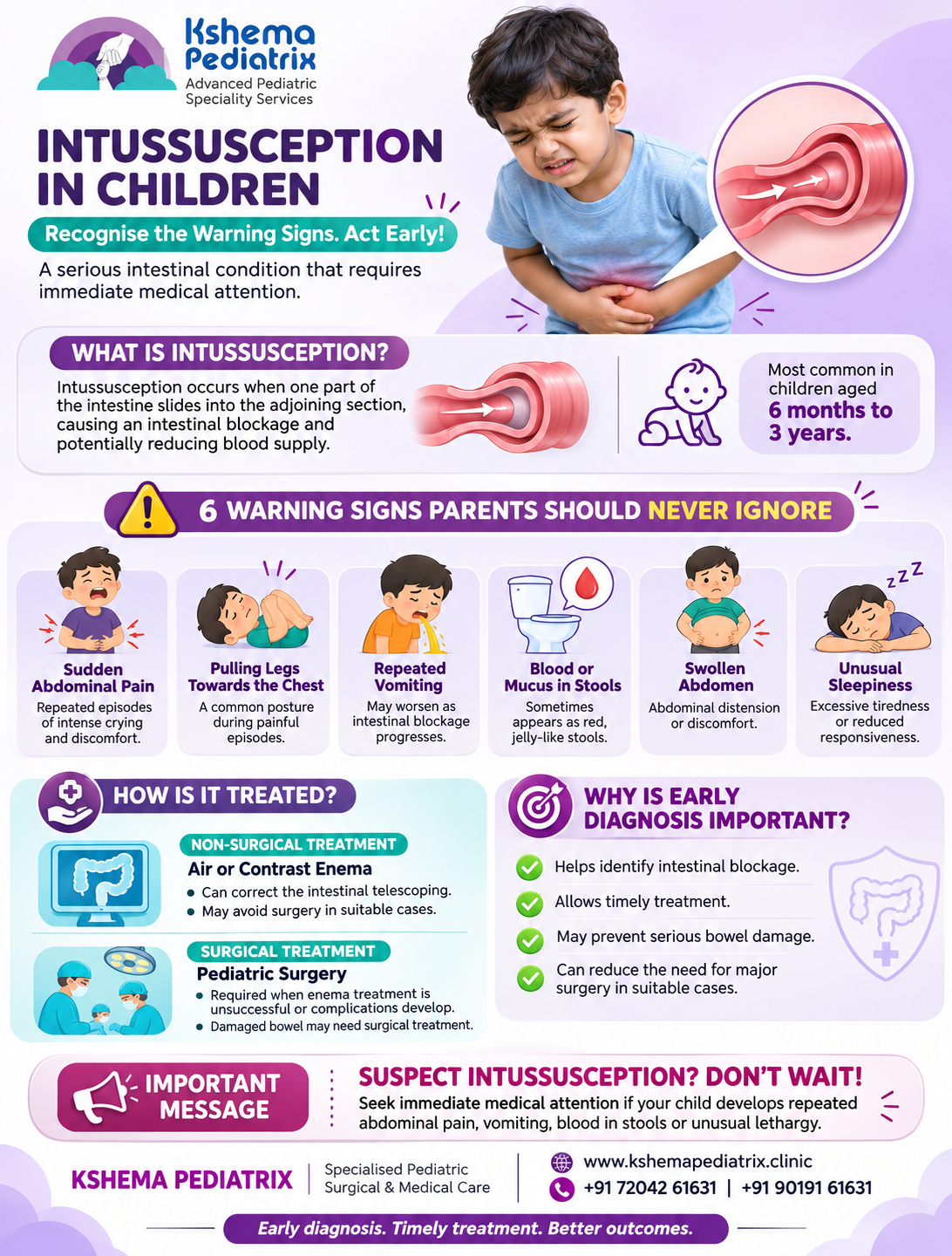
One of the biggest reasons intussusception is initially mistaken for a stomach bug or colic is its deceptive “on-and-off” pattern. Recognizing the transition from early warning signs to late-stage complications can save your child from major surgery.
1. Classic Early Warning Signs (First 6 to 12 Hours)
- Sudden, Cyclic Abdominal Pain: A previously playful infant suddenly cries out in intense pain, draws their legs up to their abdomen, turns pale, and sweats. Each episode lasts 1 to 5 minutes, followed by a 15-to-20-minute pain-free interval where the baby appears completely normal or slightly tired.
- Refusal to Feed & Irritability: Babies abruptly refuse breastmilk, formula, or solid feeds between crying spells.
- Early Non-Bilious Vomiting: Initially, the child may throw up undigested milk or stomach contents as a reflex to severe pain.
2. Progressive & Late Red Flags (Seek Pediatric Emergency Care in Bangalore Immediately)
If the telescoped bowel is not reduced promptly, the obstruction progresses and unmistakable danger signs emerge:
- Bilious (Green or Dark Yellow) Vomiting: Once the blockage becomes complete, bile backs up into the stomach. Green vomit in an infant or toddler is a cardinal surgical red flag requiring immediate pediatric emergency care in Bangalore.
- “Red Currant Jelly” Stools: Stools mixed with dark red blood and thick mucus resembling red currant jelly indicate that the intestinal lining is losing blood supply. Importantly, parents should never wait for bloody stools to appear before seeking help, as this is a late sign.
- Sausage-Shaped Abdominal Lump: A pediatric specialist can often feel a distinct, tender, sausage-like mass in the upper right side of the baby’s abdomen, accompanied by visible belly swelling.
- Profound Lethargy or Shock: Between pain episodes, the child becomes unusually limp, drowsy, difficult to wake, feverish, or pale with cool hands and feet.
What Causes Intussusception in Infants and Older Children?
The underlying trigger depends heavily on the child’s age, which is why evaluation by a specialized pediatric gastrointestinal surgeon Bangalore is essential.
Idiopathic & Post-Viral Causes in Infants (3 Months to 3 Years)
In roughly 90% of infants and toddlers, intussusception is “idiopathic” meaning there is no structural birth defect or tumor. Instead, it frequently follows 1 to 2 weeks after a common viral respiratory infection or viral gastroenteritis (stomach flu). The virus causes tiny immune lymph nodes inside the intestinal wall (known as Peyer’s patches) to swell. Normal rhythmic gut contractions (peristalsis) then grab onto this swollen lymphoid tissue and pull the bowel inward like a telescope. Boys are affected approximately two to three times more often than girls.
Pathological “Lead Points” in Children Older Than 3 Years
When intussusception occurs in children older than 3 years, or recurs multiple times, doctors look closely for an anatomical “lead point” an underlying structural abnormality that triggers the folding. Common lead points include:
- Meckel’s Diverticulum: A small congenital pouch left over from fetal development in the lower small intestine.
- Intestinal Polyps or Cysts: Benign growths or duplication cysts inside the bowel wall.
- Henoch-Schönlein Purpura (IgA Vasculitis): Small-vessel inflammation that causes localized bleeding and swelling in the intestinal wall.
- Intestinal Malrotation or Post-Surgical Adhesions: Congenital twisting abnormalities or scar bands from prior abdominal procedures.
How Pediatric Specialists Diagnose Intussusception Quickly
Because every hour matters, an experienced intussusception specialist in Bangalore relies on rapid, non-invasive bedside and imaging diagnostics rather than prolonged observation:
- Focused Clinical Examination: Your pediatric surgeon reviews the exact timeline of crying spells, vomiting color, and diaper history while gently palpating the abdomen for a mass or signs of peritonitis (abdominal guarding).
- High-Resolution Abdominal Ultrasound (Gold Standard): A painless, radiation-free abdominal ultrasound confirms intussusception with nearly 100% accuracy. On ultrasound, the telescoped bowel displays a classic “Target Sign” (or “Doughnut Sign”) in cross-section and a “Pseudokidney Sign” longitudinally. Doppler ultrasound also checks whether blood flow to the trapped bowel is still healthy.
- Blood Tests & IV Stabilization: Before any reduction procedure begins, the child is stabilized with intravenous (IV) fluids to correct dehydration, electrolyte checks, and a nasogastric tube if significant bilious vomiting is present.
Intussusception Treatment in Bangalore: Non-Surgical vs. Surgical Care
Modern intussusception treatment in Bangalore follows a clear, safety-first hierarchy: resolve the blockage non-surgically whenever safe, and reserve minimally invasive surgery strictly for complicated or irreducible cases.
1. Non-Surgical Enema Reduction (First-Line Treatment)
If your child arrives early and shows no signs of bowel perforation or severe abdominal infection, the specialist performs a non-operative reduction under real-time ultrasound or fluoroscopic X-ray guidance:
- Pneumatic (Air) Enema Reduction: A small, soft catheter is placed gently into the child’s rectum, and controlled air pressure is introduced. The gentle air pressure pushes the telescoped intestine smoothly back into its normal anatomical position.
- Hydrostatic (Warm Saline) Enema Reduction: Performed continuously under live ultrasound guidance without any radiation, warm normal saline gently unfolds the bowel while the team watches the “target sign” disappear in real time.
Non-surgical reduction takes just 15 to 30 minutes, requires no cuts or stitches, and succeeds in 85% to 90% of early cases.
2. Pediatric Laparoscopic Surgery in Bangalore (When Surgery Is Necessary)
Surgery is required in roughly 10% to 15% of cases specifically when enema reduction cannot fully unfold the bowel, when symptoms have lasted longer than 48 hours with suspected tissue damage, when imaging reveals a perforation, or when an older child has an underlying lead point like a Meckel’s diverticulum.
At Kshema Pediatrix, our team specializes in pediatric laparoscopic surgery in Bangalore. Using miniature 3mm to 5mm keyhole instruments and high-definition magnification, the surgeon gently untelescopes the bowel with minimal tissue trauma. If a short segment of bowel has lost blood supply and cannot recover, that damaged portion is safely removed and the healthy ends are reconnected (anastomosis). Keyhole surgery results in tiny scars, markedly less post-operative pain, faster return of bowel movement, and shorter hospital stays compared to traditional open incisions.
| Treatment Approach | When It Is Recommended | Procedure & Hospital Stay | Key Advantages |
| Pneumatic (Air) or Hydrostatic (Saline) Enema | Early diagnosis (<24-48 hrs), stable child, no signs of perforation or peritonitis. | 15-30 min image-guided procedure; 24-48 hours inpatient observation. | No incisions, 85-90% success rate, rapid feeding recovery. |
| Pediatric Laparoscopic (Keyhole) Surgery | Incomplete enema reduction, recurrent cases, or suspected lead point (e.g., Meckel’s). | Minimally invasive 3-5mm ports under pediatric anesthesia; 2-4 days stay. | Tiny scars, less pain, thorough inspection for lead points. |
| Open Pediatric Bowel Surgery | Late presentation with bowel perforation, peritonitis, or gangrenous bowel resection. | Targeted abdominal incision with bowel repair/resection; 4-7 days stay. | Direct life-saving control of abdominal infection and tissue repair. |
Recovery, Recurrence Risk, and Post-Treatment Care at Home
Following a successful air or saline enema reduction, your child is monitored in the hospital for 24 to 48 hours. Once abdominal cramps subside and your child passes normal gas or stool, clear liquids and breastmilk or bland feeds are gradually reintroduced.
Parents should be aware that intussusception carries an 8% to 10% chance of recurring most commonly within the first 24 to 72 hours after non-surgical reduction. Before discharge from our partner pediatric surgery hospital in Bangalore, we equip every parent with a clear home-monitoring checklist. If sudden cyclic crying, knee-drawing pain, or vomiting returns at home, prompt re-evaluation ensures immediate repeat care.
Why Choose Kshema Pediatrix for Pediatric Emergency & Surgical Care in Bangalore?
When your child faces an acute abdominal emergency, outcome quality depends on rapid coordination between pediatric surgeons, pediatric radiologists, and dedicated pediatric anesthesiologists. Led by Dr. Ramesh Santhanakrishnan widely recognized among parents and peers as the pediatric surgeon in Bangalore with over 33 years of clinical excellence and 25,000+ successful pediatric procedures Kshema Pediatrix delivers unmatched surgical precision with a compassionate, child-first approach.
- Pioneering Minimal Access Expertise: Dr. Ramesh Santhanakrishnan is a pioneer in pediatric laparoscopy in India, ensuring the smallest possible incisions and fastest recovery when surgery is needed.
- Seamless Tertiary Hospital Access: Through our affiliated NABH-accredited child specialist hospital in Bangalore network, families gain immediate 24/7 access to ultrasound diagnostics, pediatric radiology, and dedicated NICU/PICU backup.
- Convenient South Bangalore Location: Located on Bull Temple Road in Basavanagudi (easily accessible from Jayanagar, Banashankari, JP Nagar, and Kanakapura Road), our clinic offers transparent counseling and rapid emergency triage.
Frequently Asked Questions About Intussusception in Children
- What is the most common age for intussusception in children?
Intussusception occurs most frequently in infants and toddlers between 3 months and 3 years of age, with peak incidence between 5 and 10 months. However, it can occasionally affect newborns, older children, and teenagers. - How can I tell the difference between normal baby colic and intussusception?
Routine colic usually occurs at predictable evening times and improves with gentle rocking, burping, or passing gas. Intussusception causes sudden, severe, inconsolable screaming where a previously healthy baby pulls their knees to their chest for a few minutes, stops abruptly for 15–20 minutes, and repeats the cycle alongside vomiting or unusual lethargy. - Is intussusception a medical emergency in Bangalore?
Yes. Intussusception is a true pediatric surgical emergency. Because the telescoped bowel cuts off its own blood supply, seeking immediate pediatric emergency care in Bangalore within the first 24 hours dramatically increases the chance of non-surgical enema cure and prevents bowel perforation. - Does every child with intussusception have “red currant jelly” stools?
No. Red currant jelly stool (blood mixed with mucus) is actually a late sign seen in fewer than 30% to 40% of early cases. Never wait for bloody stools before consulting a pediatric surgeon in Bangalore if your child has cyclic abdominal pain and vomiting. - Can intussusception resolve on its own without treatment?
While very brief, transient small-bowel intussusceptions occasionally self-resolve on ultrasound, true ileocolic intussusception rarely resolves spontaneously. Attempting home remedies or delaying intestinal obstruction treatment in children Bangalore risks bowel gangrene and life-threatening peritonitis. - What causes intussusception in babies?
In 90% of infants, the exact cause is unknown (idiopathic), though it frequently follows a recent viral cold or stomach infection that causes lymph tissue (Peyer’s patches) in the intestinal wall to swell and telescope inward. - How is intussusception diagnosed without radiation?
High-resolution abdominal ultrasound is the gold-standard diagnostic test. It is completely painless, involves zero radiation, and detects the classic “target sign” of intussusception with near-100% accuracy within minutes. - How does non-surgical intussusception treatment in Bangalore work?
Under live ultrasound or X-ray guidance, a specialist gently introduces air (pneumatic enema) or warm saline (hydrostatic enema) through a small tube in the rectum. The gentle pressure unfolds the telescoped intestine back into place without any surgical cuts. - What is the success rate of air or saline enema reduction?
When a child is brought to an experienced pediatric center within 24 to 48 hours of symptom onset, non-surgical pneumatic or hydrostatic enema reduction succeeds in 85% to 90% of cases. - When is pediatric laparoscopic surgery in Bangalore required for intussusception?
Minimally invasive pediatric laparoscopic surgery in Bangalore is recommended if enema reduction fails to completely unfold the bowel, if the child shows signs of intestinal perforation or peritonitis, or if an older child has an underlying structural lead point like a Meckel’s diverticulum or polyp. - Is general anesthesia safe for infants undergoing intussusception surgery?
Yes, when administered by dedicated pediatric anesthesiologists using weight-calibrated protocols and continuous monitoring inside a fully equipped pediatric surgery hospital in Bangalore. - How long does a child stay in the hospital after intussusception treatment?
After a successful non-surgical enema reduction, most children stay in the hospital for 24 to 48 hours to confirm normal feeding and monitor for early recurrence. If laparoscopic or open surgery is needed, the stay typically ranges from 2 to 5 days. - Can intussusception come back after treatment?
Yes, recurrence happens in roughly 8% to 10% of children treated with non-surgical enema reduction, most often within the first 24 to 72 hours. If it recurs, a repeat enema reduction or laparoscopic evaluation is performed. - Who should I consult for pediatric bowel emergencies in South Bangalore?
You should consult a qualified MCh-trained specialist such as Dr. Ramesh Santhanakrishnan at Kshema Pediatrix, Basavanagudi widely trusted as the Pediatric surgeon in Bangalore with over 33 years of surgical experience. - How can I book an urgent consultation at Kshema Pediatrix, Bangalore?
For urgent guidance or appointments at Kshema Pediatrix (No. 110, 1st Floor, Bull Temple Road, Basavanagudi, Bengaluru 560019), parents can call or WhatsApp +91 72042 61631 / +91 90191 61631 or visit www.kshemapediatrix.clinic.
Take the Next Step for Your Child’s Health
When your child’s health is on the line, don’t settle for generic rankings or media fame. Focus on what truly impacts surgical outcomes: specialized training, advanced minimal access techniques, and compassionate care.
If you are looking for an expert pediatric surgeon in Bangalore, reach out to our team at Kshema Pediatrix Clinic today. We are committed to providing your child with the gentlest, most effective surgical care possible.
👉 Book a Consultation at Kshema Pediatrix Clinic
Doctor & Clinic Location Details (Bangalore)
-
Clinic: Kshema Pediatrix
-
Address: No. 110, 1st Floor, Bull Temple Road (Between Ramakrishna Ashrama & Doddaganesha Temple), Basavanagudi, Bangalore, Karnataka 560019
-
Location: Basavanagudi / Hanumanthnagar / Banashankari region, South Bangalore
-
Website: www.kshemapediatrix.clinic
